Most real estate investment content reads the same way. Buy in markets with population growth. Look for low vacancy rates. Calculate the cap rate. Find a property manager. Repeat.
That framework is not wrong. It is just incomplete when applied to a specific city, and Albuquerque is a city where the details matter considerably more than the general framework suggests.
This is the conversation Tori Domaille has been having with investor clients at Elite Homes Realty since 1996. The version that covers what the numbers look like here, which neighborhoods produce which types of returns, what Albuquerque renters actually need, and where the deals that look best on a spreadsheet fall apart in practice.
Why Albuquerque consistently attracts real estate investors
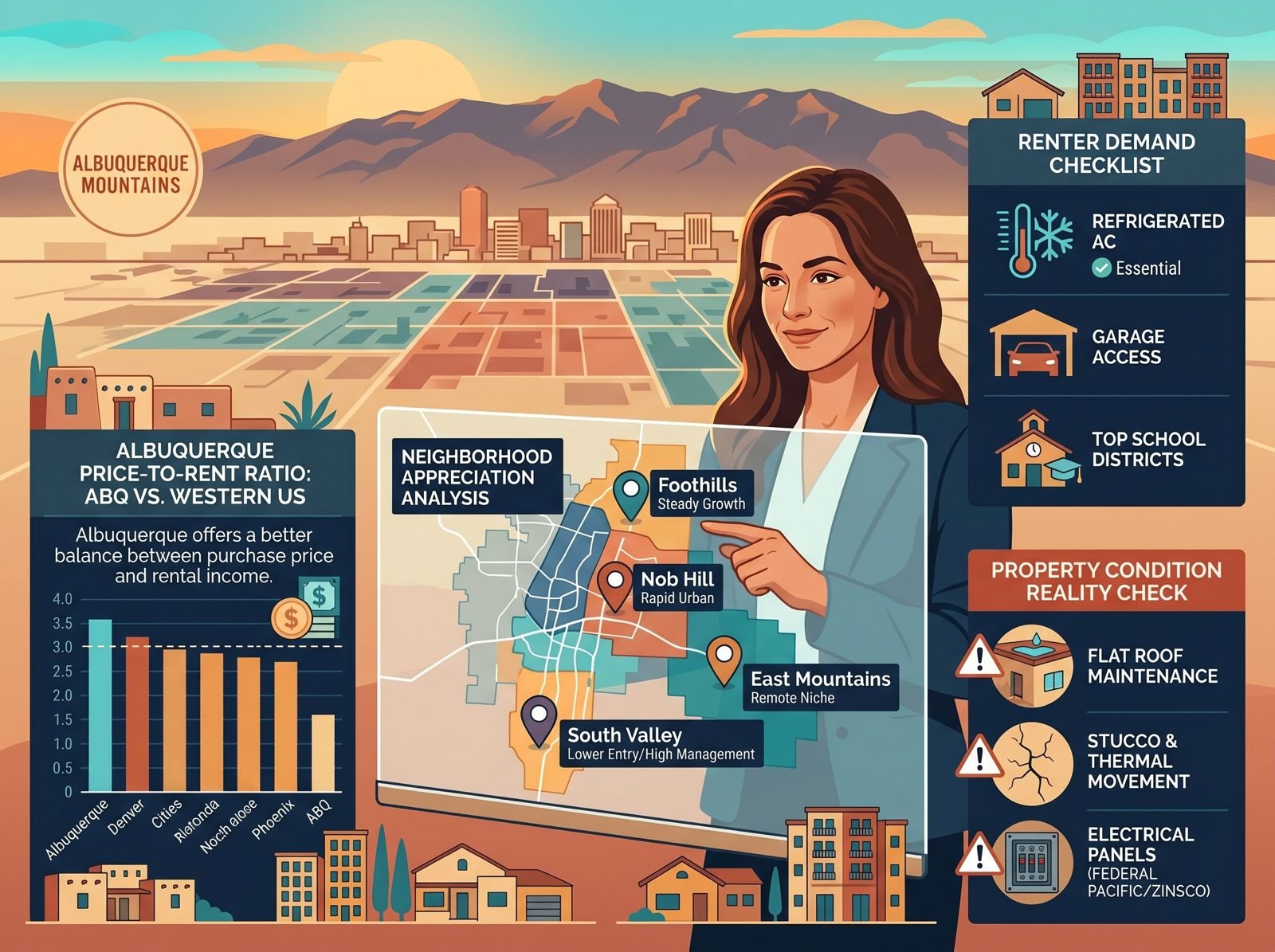
The case for Albuquerque as an investment market starts with the price-to-rent ratio, the relationship between what a property costs to acquire and what the local rental market will support as monthly income.
In markets where home prices have run well ahead of rental rates, which describes most of the Western United States over the past decade, the math on a rental property gets difficult fast. The purchase price requires either a large down payment to achieve cash flow, a significant appreciation assumption to justify holding the asset, or both. Investors in those markets are frequently making a bet on price appreciation rather than a decision based on the property’s current income.
Albuquerque has not run that same race. Home prices here have appreciated, meaningfully in certain neighborhoods, but not at the pace that collapsed the cash flow math the way it did in Denver, Phoenix, or Austin. A property that rents for $1,400 per month in Albuquerque costs considerably less to acquire than a comparable rental in those markets, so the income-to-purchase-price relationship still makes sense for investors seeking a property that pays its own way.
The rental demand side of the equation is supported by several structural factors that do not go away in a slow economic year. The University of New Mexico enrolls roughly 25,000 students. Kirtland Air Force Base generates a consistent rotation of military families who need housing for two to three-year assignments. Sandia National Laboratories and the Department of Energy employ thousands of workers who predominantly rent rather than buy because of assignment uncertainty. These demand sources are not dependent on a hot economy, they run at a relatively steady baseline regardless of what the broader market is doing.
What appreciation looks like in Albuquerque, and what drives it
Albuquerque appreciation is neighborhood-specific in a way that a citywide average obscures almost entirely.
The Foothills and North Albuquerque Acres have appreciated steadily over the past two decades because the land constraints are real. The Sandia Mountains to the east and the existing built environment to the west limit the extent to which new supply can come to market in those areas. Buyers seeking Foothills proximity, mountain views, and larger lots have a finite number of properties to compete for, and finite supply with consistent demand supports prices over time.
The Downtown and Nob Hill corridor has seen sharper appreciation over the past decade than its historical pattern would suggest. The investment in the Route 66 corridor, the growth of the Nob Hill commercial district, and the arrival of buyers who prioritize walkability and architectural character over square footage have moved prices in this area faster than many parts of the Northeast Heights.
The South Valley and some of the older residential neighborhoods in the central city have appreciated from a lower base and remain areas where an investor can acquire at a lower price point, but the tenant management picture, the maintenance demands of older housing stock, and the longer hold period required to see meaningful appreciation create a different investor profile than a Foothills purchase does.
The East Mountains, Cedar Crest, Tijeras, the communities above the canyon, represent a smaller, more specific investment case. Properties here attract a particular renter: someone with a remote work arrangement who wants mountain living without paying Santa Fe prices. Vacancy risk is higher because the pool of qualified tenants is smaller, but the properties that do rent here command a premium over their purchase price for the right buyer.
Single-family versus multi-family in Albuquerque, the real trade-off
Both asset types work in Albuquerque. The decision depends entirely on what an investor is trying to accomplish and what their operational capacity looks like.
Single-family homes in established Albuquerque neighborhoods tend to attract longer-term tenants. A family that moves into a three-bedroom home in Four Hills or North Albuquerque Acres with good schools and a yard does not move every year, they stay for three, four, or five years if the property is well managed and rent increases stay within reasonable bounds. That stability reduces vacancy costs, turnover costs, and the management overhead that eats into returns on properties with frequent tenant changes.
The trade-off is that a single-family property generates a single income stream. If that tenant leaves, the income stops completely until the next tenant is in place. An investor with one or two single-family rentals is fully exposed to vacancy in a way that a multi-unit operator is not.
Small multi-family properties, duplexes, triplexes, and fourplexes, exist across several Albuquerque neighborhoods in meaningful numbers, particularly in the older housing stock of the Northeast Heights and the Central Avenue corridor. These properties allow an investor to distribute vacancy risk across multiple units while still managing the asset without a full property management infrastructure.
The financing picture for multi-family changes at the five-unit threshold. Properties with four or fewer units qualify for residential financing, the same loan products available for a primary residence purchase. Five units and above shift to commercial lending, which involves different underwriting standards, higher down payments, and shorter amortization periods. Most individual investors in Albuquerque stay below that threshold to preserve the financing flexibility it provides.
What Albuquerque renters actually need, and what drives vacancy
Understanding what renters in Albuquerque’s market are specifically looking for reduces vacancy in a way that no amount of marketing can correct for.
Cooling system type matters more in this market than most investors from other regions anticipate. Albuquerque’s older housing stock has a significant proportion of properties that still use evaporative cooling, swamp coolers, as the primary summer cooling system. These work well for most of the year in the dry climate but lose effectiveness during the July through September monsoon season when humidity rises. A renter choosing between a comparable property with refrigerated air conditioning and one with evaporative cooling will choose refrigerated at the same price point every time. Properties that have made the conversion attract and retain tenants more consistently.
Garage access is a consistent priority for Albuquerque renters, particularly in the winter months when overnight temperatures drop, and ice on windshields is a real morning issue. Properties without covered parking rent slower and lose competitive applicants to comparable properties that have it.
School district boundaries matter enormously for the family rental segment. Albuquerque Public Schools operates within a complex boundary system that does not always follow intuitive neighborhood lines. A property two blocks outside a desirable school boundary rents to a different tenant pool than one inside it, at a different price point and with different turnover characteristics. Investors who understand where these boundaries fall make better acquisition decisions.
The property condition reality in Albuquerque’s investment market
Albuquerque has a substantial inventory of older housing stock, properties built between the 1950s and 1980s that have appreciated meaningfully in certain neighborhoods and represent the most accessible price points for investors entering the market.
These properties come with specific maintenance patterns that an investor needs to price into their acquisition analysis before making an offer.
Flat and low-slope roofs are common in Southwest architecture throughout this era of construction. They require periodic recoating and drainage maintenance, deferred flat roof maintenance leads to interior water damage faster than a pitched roof failure does, and the cost of addressing it after damage has occurred is several times the cost of the preventive maintenance that would have prevented it.
Stucco exterior maintenance on properties of this age involves regular inspection for cracking at penetrations, corners, and trim lines. Albuquerque’s temperature swings between day and night are among the widest of any American city, a 40- to 50-degree daily range is not unusual in spring and fall, and that thermal movement works on stucco over decades in ways that require periodic attention.
Original electrical panels in properties built before the mid-1980s, particularly Federal Pacific and Zinsco panels, have documented reliability issues and pose insurance complications that affect a property’s insurability. Replacement is a capital cost that investors in this price range need to budget for.
None of these are disqualifying conditions. They are knowable costs that belong in the underwriting rather than discoveries that show up after closing.
Working with Elite Homes Realty as an investor
Investor clients have different needs from primary-residence buyers, and the agent relationship works differently as a result.
Finding a property is a smaller part of the process than evaluating it. An investor needs accurate rental rate data for the specific property type and neighborhood, an honest assessment of the maintenance condition and what it means for near-term capital expenditures, and a clear picture of the tenant pool for that property and how it behaves over time.
Tori Domaille has been closing investment transactions in Albuquerque since 1996. That history includes acquisitions across every neighborhood category, in markets that were hot, flat, and declining, on properties that were well-maintained and ones that required substantial work before they performed as intended. The team at Elite Homes Realty knows which areas of the city produce which types of investor experiences, and that knowledge is available during the consultation, before any offer is written.
For investors coming from out of state or approaching the Albuquerque market for the first time, the starting point is a conversation about investment goals, budget, and what level of operational involvement makes sense for how the investor wants to hold the asset. That conversation shapes the property search in a way that a listing-first approach does not.
Elite Homes Realty 📍 8812 Natalie Ave NE, Albuquerque, NM 87111 📞 +1 (505) 639-0067 🔗 buyorsellabq.com
Tori Domaille is the Broker and Owner of Elite Homes Realty and has worked in Albuquerque real estate since 1996. The team serves investors, buyers, and sellers across Albuquerque, Placitas, Rio Rancho, and the East Mountains.