Most people walk into the Albuquerque real estate market with a Zillow tab open and a rough number in their head. They scroll through listings, fall in love with photos taken in perfect afternoon light, and show up to their first walkthrough completely unprepared for what the city actually asks of a buyer.
This guide is not that experienced.
What follows is the kind of conversation Tori Domaille has been having with buyers since 1996 — the real one, before the paperwork starts. The one that saves you months of wrong turns and gets you into the right neighborhood the first time.
Why Albuquerque Is Not Like Other Markets
There is something genuinely unusual about buying property in Albuquerque. The city does not behave the way national real estate headlines suggest. When coastal markets overheat, ABQ holds steady. When interest rates spike and buyers elsewhere pause entirely, the Albuquerque market keeps moving — slower in some pockets, but moving.
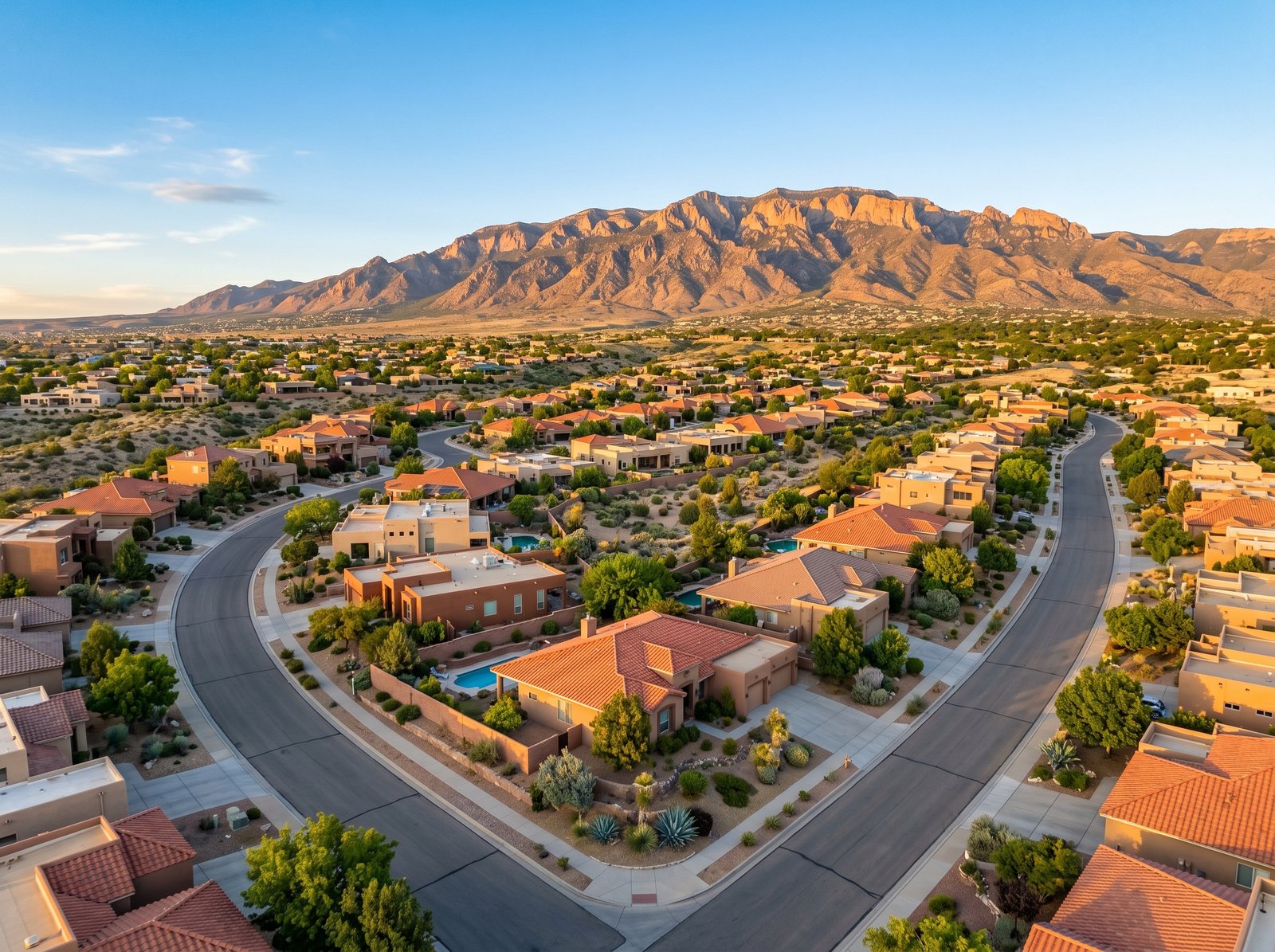
Part of that comes down to geography. Albuquerque sits in a high desert valley at roughly 5,300 feet. That physical boundary naturally limits how far the city can sprawl, which keeps certain neighborhoods consistently in demand regardless of broader market conditions.
The other part is the population. Albuquerque draws a consistent mix of retirees relocating from higher cost-of-living states, University of New Mexico-affiliated buyers, government and military families tied to Kirtland Air Force Base and Sandia National Laboratories, and an increasing wave of remote workers who discovered that a three-bedroom home with a mountain view in ABQ costs considerably less than a studio apartment in the cities they left.
What that means for you as a buyer is this: inventory moves. If you find something that genuinely fits your needs, the conversation about moving forward needs to happen quickly and clearly.
Albuquerque Neighborhoods — The Real Breakdown
One of the biggest mistakes buyers make is treating Albuquerque like a single, uniform market. It is not. The difference between neighborhoods here is not just aesthetic — it is lifestyle, commute, school district, elevation, and long-term value trajectory. Here is what you actually need to know about each area.
The Foothills
If you have driven east toward the Sandias and noticed the homes climbing toward the mountain, you have already seen the Foothills from a distance. This is one of Albuquerque’s most consistently desirable areas — not because of any single feature, but because of what the entire package delivers.
Lots tend to be larger here. The elevation above the city floor means you get genuine views — not just of the mountains behind you, but of the Rio Grande Valley stretching west on clear days, which in New Mexico is most days. The neighborhood is quiet, established, and populated largely by long-term residents who bought years ago and have stayed.
Buyers come to the Foothills looking for space, privacy, and a sense of permanence that newer developments simply cannot yet replicate. If that matches what you are looking for, competition in this area is real. Homes that hit the market properly priced tend to generate interest quickly, particularly at the entry level of the Foothills price range.
Placitas
Placitas sits just north of Albuquerque in Sandoval County — far enough from the city to feel genuinely rural, close enough to make a daily commute manageable if your work requires it.
What draws buyers to Placitas is the land. Properties here often come with acreage rather than standard city lots, which means horses, workshops, guest casitas, and genuine outdoor space are realistic possibilities rather than wishful thinking. The high desert landscape around Placitas has a particular quality — wide open, quiet, with the kind of sky that city living does not offer.
This is the right area for buyers who want property that gives them something to do with it — not just a house to live in, but land to steward, build on, or simply enjoy.
Downtown ABQ
Downtown Albuquerque has changed more in the past decade than at any point in the city’s recent history. Historic Route 66, Nob Hill, and the EDo arts district have attracted significant investment to the urban core, and that shift is evident in the property market.
Buyers who choose Downtown are typically not looking for acreage. They want walkability, culture, proximity to the restaurant and arts scene, and the kind of neighborhood character that takes generations to build. Historic adobe homes sit alongside renovated mid-century properties and newer infill construction, which means the Downtown buyer needs to know what they are getting into structurally before falling in love with a photograph.
The right agent in this area is one who understands what has been renovated properly and what has been cosmetically updated to look current without addressing what is underneath. There is a significant difference.
East Mountains
The East Mountains — Cedar Crest, Tijeras, Edgewood, and surrounding communities — sit on the other side of the Sandia and Manzano ranges from Albuquerque proper. Elevation here runs significantly higher than the city, which means genuine four-season weather, cooler summers, and a landscape that looks dramatically different from the desert floor.
Properties in the East Mountains attract buyers who want the mountain living experience without being out of driving distance of the city. It is a 25 to 40-minute commute, depending on exactly where you land, and for buyers who work remotely even a few days a week, that calculus changes considerably.
Value here tends to be strong relative to what you get — square footage, land, and natural setting that would command a significant premium in mountain communities in Colorado or Arizona.
Four Hills
Four Hills sits southeast of the city center and occupies an interesting position in the market — established enough to have genuine neighborhood character, accessible enough for buyers who need to move through the city efficiently, and priced in a range that gives first-time buyers and move-up buyers both a realistic path.
The area includes a range of property styles and sizes, which means the search process here benefits from someone who knows the streets — which blocks hold the most value, which sections of Four Hills have seen the most consistent maintenance, and what the neighborhood’s long-term trajectory looks like from an investment standpoint.
North Valley
The North Valley is one of Albuquerque’s most distinctive and genuinely irreplaceable areas. It runs along the Rio Grande, and the neighborhood’s agricultural heritage — the acequia systems, the old cottonwood bosque, the sprawling lots — creates something that simply does not exist anywhere else in the metro.
North Valley buyers are buying into a lifestyle as much as a property. Horses are common. Large gardens are viable. The lots are generous, the trees are mature, and the neighborhood’s overall character reflects decades of care by owners who treated their property as something worth investing in.
Inventory here is limited by definition. The North Valley does not expand — it is what it is, and what it is happens to be one of the most sought-after pockets of Albuquerque real estate available.
North Albuquerque Acres
North Albuquerque Acres — NAA to locals — offers something that is increasingly rare in any metro market: genuine one-acre lots inside city limits. The properties here give buyers the space of a rural setting with the convenience of full city services and a reasonable commute to virtually anywhere in Albuquerque.
For families who need room, buyers who want a shop or detached workspace, or anyone who finds standard subdivision lots simply too small for how they actually live, North Albuquerque Acres deserves serious consideration.
What the Albuquerque Market Actually Requires From a Buyer in 2025
Understanding the neighborhood is step one. Understanding what the market operationally requires from you as a buyer is step two — and this is where many buyers lose time and opportunity by coming in unprepared.
Get pre-approved before you look seriously. This is not a formality in Albuquerque any more than it is in any other active market. A pre-approval letter tells a seller that your offer is backed by something real. In a situation where a well-priced home attracts multiple offers — which happens regularly in the neighborhoods described above — the buyer without documentation simply does not compete.
Understand what a free home valuation actually tells you. Before making any offer, you need to understand what comparable properties have actually sold for — not what they were listed at, but what buyers paid at the closing table. A comparative market analysis strips away the noise and shows you the real price landscape. This is a service Elite Homes Realty provides without charge, and it is one of the most practically useful steps any buyer can take before entering serious negotiations.
Build your inspection expectations around the desert climate. Albuquerque’s dry heat creates specific property conditions that buyers from other regions sometimes miss. Stucco exterior maintenance, roof drainage during the monsoon season, evaporative versus refrigerated cooling systems, and the particular ways adobe and frame construction behave over decades are all things a thorough inspection should address. Come in knowing these are the questions to ask, not learning about them after you have already closed.
Think about resale from day one. Even if this is the home you intend to stay in for twenty years, the characteristics that make a property easy to resell are often the same characteristics that make it genuinely livable — good natural light, functional layout, location within the neighborhood, lot size, and usability. Buying with resale in mind is not cynical. It is just good thinking.
The Difference a Local Agent Actually Makes
There is a version of this transaction where you find a listing online, contact whoever is listed on the sign, and hope for the best. A lot of buyers go this route, and some of them end up fine.
But in a city with as many distinct pockets and as much neighborhood-specific nuance as Albuquerque, the agent you work with determines how much of the market you actually have access to — and how clearly you understand what you are buying before you commit.
Tori Domaille has been working in this market since 1996. That is not a number for a website header — it is nearly three decades of transactions across every market condition Albuquerque has produced, from the expansion years of the early 2000s through the corrections that followed, and through every recovery and shift since.
The team at Elite Homes Realty — including Jennifer Peixotto and Lori Anne Gray, who brings 25 years of her own professional experience to every transaction — works as a genuine unit. What one of them knows about a neighborhood or a specific property type, the whole team brings to your search.
That kind of institutional knowledge does not come from a national brokerage algorithm. It comes from showing up in this city, for these clients, for years.
Starting the Conversation
The first step is not finding a listing. The first step is a conversation about what you actually need — your timeline, your budget, your non-negotiables, and the neighborhoods where the life you want actually exists.
That conversation costs nothing and changes everything about how efficiently the search goes from there.
Elite Homes Realty serves buyers across Albuquerque and the surrounding communities — including Placitas, the East Mountains, and the established neighborhoods of the North Valley and Foothills.
Ready when you are.
📞 +1 (505) 639 0067 📍 8812 Natalie Ave. NE, Albuquerque, NM 87111 🔗 buyorsellabq.com