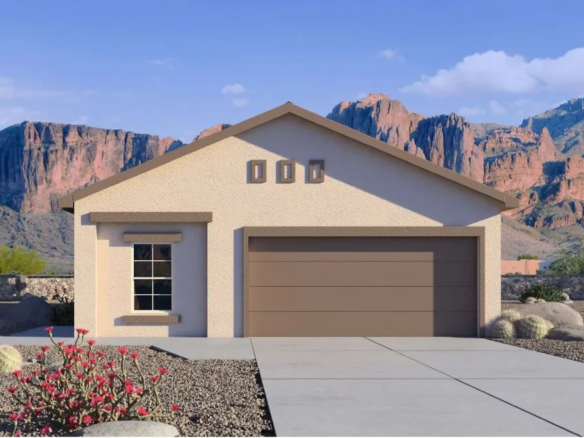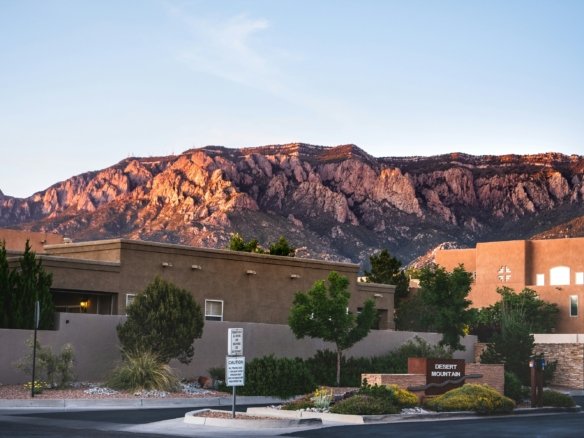
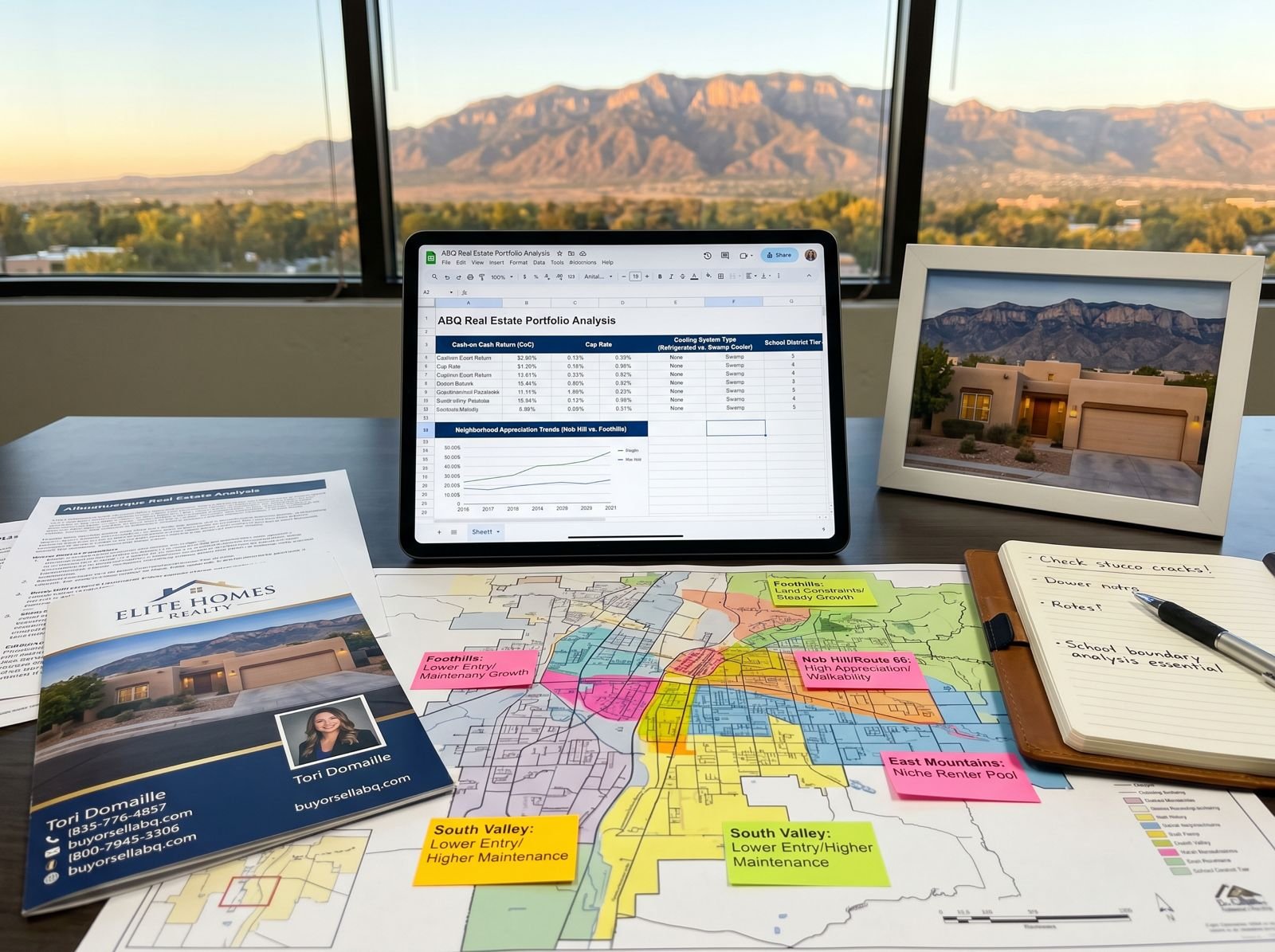
There is a particular kind of buyer who ends up in the East Mountains. They have usually spent time in Albuquerque proper — either living there or visiting — noticed the mountains rising to the east of the city, and started asking the question that leads to this guide.
What is actually up there? What does it cost? What does the commute look like on a Tuesday morning in February? And is the lifestyle as different as it appears from the valley floor?
The answers are specific, the trade-offs are real, and the buyers who go in with clear information make considerably better decisions than the ones who fall in love with an elevation and a view before understanding what comes with them.
Tori Domaille and the team at Elite Homes Realty have been working the East Mountains market alongside the Albuquerque valley for nearly three decades. This guide is the conversation they have before the first property tour.
What the East Mountains actually are — geographically and practically
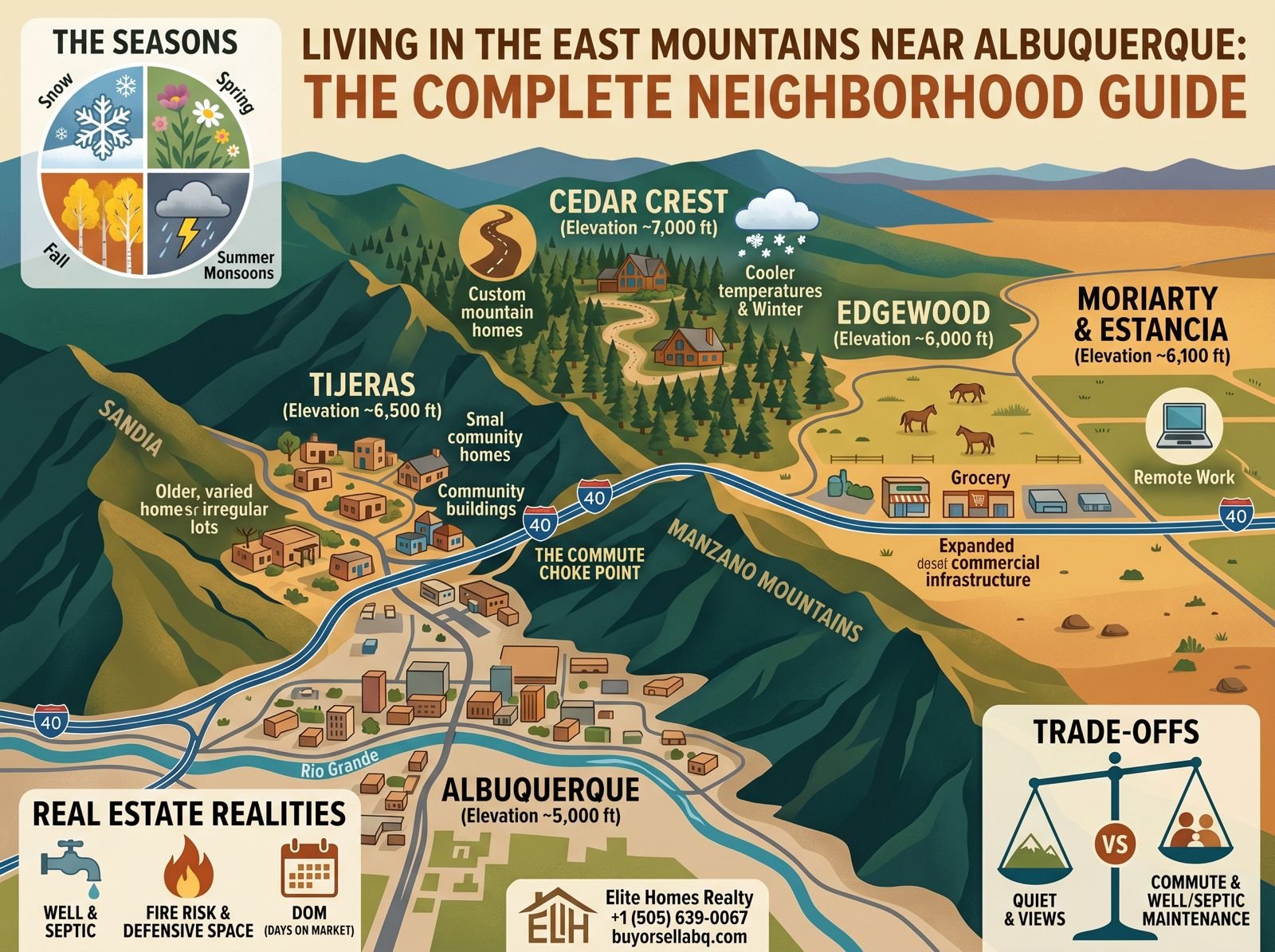
The East Mountains is the informal name for the communities that sit on the eastern slope and eastern plain of the Sandia and Manzano mountain ranges, accessible from Albuquerque primarily via Interstate 40 through Tijeras Canyon and via State Road 14, which locals call the Turquoise Trail.
The communities that fall within what most buyers mean when they say East Mountains include Tijeras, Cedar Crest, Edgewood, Moriarty, Estancia, and a collection of smaller communities and subdivisions that sit at various elevations along the range. Each of these places is genuinely different from the others in terms of character, price point, lot size, and practical commute reality — and treating them as a single uniform market is the first mistake buyers make.
Elevation across the East Mountains ranges from roughly 6,000 feet in Edgewood and Moriarty on the eastern plain to over 7,000 feet in Cedar Crest and Tijeras. That 1,000-foot difference in elevation produces a meaningfully different climate — more precipitation, colder winters, more dramatic weather events, and a landscape that shifts from high desert scrub to piñon and juniper woodland to ponderosa pine as you gain altitude.
Cedar Crest — where most East Mountains buyers end up first
Cedar Crest is the community that gets the most attention from buyers coming from Albuquerque, and for understandable reasons. It sits at the highest accessible elevation of the main East Mountains communities — around 6,800 to 7,200 feet depending on the specific subdivision — which means ponderosa pines, cooler summer temperatures, and the mountain character that buyers are picturing when they first start asking about the East Mountains.
The commute from Cedar Crest to central Albuquerque runs 25 to 40 minutes under normal conditions via I-40 through Tijeras Canyon. The canyon is the choke point. Under winter road conditions — which happen several times between November and March — that commute extends considerably, and the stretch of I-40 through the canyon closes periodically during significant storm events. Buyers who need reliable daily commute predictability need to experience the canyon in winter, not just on a clear October afternoon, before making a purchase decision based on commute tolerance.
Properties in Cedar Crest range from modest homes on half-acre lots in established subdivisions to custom-built mountain homes on several acres with privacy and views that require a winding dirt road to access. The price range follows that spread. Entry-level Cedar Crest homes start below the Albuquerque Foothills price point, which makes them accessible to buyers who want mountain character without the premium that the urban-adjacent Foothills commands.
What Cedar Crest does not have in abundance is commercial infrastructure. The community has a small commercial corridor along the main road — a hardware store, a few restaurants, a grocery option — but it is not a walkable amenity environment. Buyers who want to walk to coffee or groceries are in the wrong place. Buyers who want thirty minutes of peace between the workday and arriving home are exactly in the right one.
Tijeras — the entry point with the most urban proximity
Tijeras sits at the mouth of the canyon, roughly 15 miles east of central Albuquerque, at an elevation of around 6,500 feet. Of the East Mountains communities, Tijeras has the shortest commute into the city — 20 to 30 minutes under normal conditions — and the most immediate sense of transition between the Albuquerque valley and the mountain environment.
The housing stock in Tijeras skews older and more varied than Cedar Crest. Properties here include older adobe and frame homes on irregular lots, some manufactured housing, and a smaller number of custom builds. The price points are generally lower than Cedar Crest at comparable lot sizes, which attracts buyers who want East Mountains proximity at an accessible entry price.
The trade-off in Tijeras is lot size. The terrain close to the canyon mouth is steeper and more constrained than the open subdivisions of Cedar Crest, which means the spacious flat lots that buyers picture when they think mountain property are less common here than in communities further east along the plateau.
Tijeras works best for buyers who want the fastest commute and the genuine mountain feel without committing to the full geographic separation that Cedar Crest or Edgewood requires. It is a reasonable starting point for buyers who are not certain how much separation from the city they actually want until they live with it for a few months.
Edgewood — the practical East Mountains choice most buyers overlook
Edgewood sits east of the mountains on the Estancia Valley plain, roughly 40 miles from Albuquerque at about 6,000 feet elevation. The landscape here is different from the forested higher elevations — open high desert, wider sky, longer sight lines across the basin toward the Manzano Mountains to the south.
Buyers who focus on Cedar Crest and Tijeras often overlook Edgewood, which is a mistake when the priorities are lot size, price per square foot, and what the budget actually buys relative to the rest of the East Mountains market.
Properties in Edgewood offer considerably more land for the same purchase price than comparable homes in Cedar Crest. One to five acre lots at accessible price points are common here. The town itself has more commercial development than Tijeras or Cedar Crest — a grocery store, a hardware store, medical services, and a growing number of small businesses that serve a population that has been steadily growing as remote work has made the longer commute viable for more buyers.
The commute from Edgewood to Albuquerque runs 45 to 60 minutes under normal conditions. That is the honest number, not the optimistic one from a mapping app at 2 PM on a Sunday. For buyers who commute daily, that time cost needs to be genuine personal tolerance tested against the property benefit, not rationalized on a spreadsheet. For buyers who commute two or three days per week — which describes an increasing portion of the workforce — the commute calculus looks meaningfully different.
Moriarty and Estancia — the far eastern option for buyers who want real acreage
Moriarty and Estancia sit further east on the Estancia Valley plain, 50 to 60 miles from Albuquerque. Properties here move into genuine acreage territory — 5, 10, 20 acres are realistic options at price points that would not buy a quarter-acre lot in the Foothills.
This is not the East Mountains in the way that Cedar Crest or Tijeras is. The mountain character gives way entirely to open plain. The commute to Albuquerque is an hour or more. The infrastructure is rural. Buyers who come here are not splitting the difference between mountain living and city access — they are choosing land and space as the primary value and accepting that everything urban requires a drive.
For the right buyer — someone who works remotely full time, wants horses or agricultural land, or simply needs space that no closer-in community can provide at a reasonable price — Moriarty and Estancia represent genuine value. For buyers who are unclear whether they want rural or semi-rural, starting this far east is a risk that Cedar Crest or Edgewood does not carry.
The seasonal reality — what buyers from outside New Mexico do not anticipate
The East Mountains produce a genuine four-season climate that differs substantially from the Albuquerque valley floor in ways that affect daily life throughout the year.
Winter in Cedar Crest and Tijeras involves real snowfall — multiple times per year, sometimes in accumulations that require clearing before the car leaves the driveway. Properties with long private driveways require a different maintenance posture than valley homes. A four-wheel-drive vehicle is a practical necessity rather than a recreational choice for buyers who live above 7,000 feet. Road conditions through the canyon vary from clear to hazardous within hours during winter storm events.
Summer in the East Mountains is the season that sells it. While Albuquerque valley temperatures frequently exceed 95 degrees from June through August, Cedar Crest and the higher East Mountains communities run 10 to 15 degrees cooler. The monsoon season brings afternoon thunderstorms that are dramatic and frequent — often daily through July and August — which means properties need functional drainage and any low-water crossing on a private road needs to be understood before, not after, purchasing a property that depends on crossing it.
Spring and fall at elevation are genuinely beautiful in a way that the valley does not replicate — wildflower seasons in late spring, aspen color in the higher elevations in October — but they also bring the highest wind events of the year, and properties surrounded by ponderosa pines need periodic assessment for fire risk and dead tree removal.
What the property search looks like in the East Mountains market
The East Mountains market operates differently from the Albuquerque valley in ways that affect how buyers need to approach it.
Days on market tend to be longer in the East Mountains than in competitive Albuquerque valley neighborhoods. This is partly a function of the smaller buyer pool for any given property and partly a function of the more specific buyer profile the properties attract. The practical implication is that the rush-to-offer urgency that applies in Foothills or Northeast Heights transactions is less common here — which gives buyers more time to think but should not be mistaken for a sign that well-priced properties do not sell.
Well water and septic systems are the norm across most of the East Mountains rather than city water and sewer connections. Buyers coming from urban backgrounds who have only ever dealt with municipal utilities need to understand what maintaining these systems involves — septic pumping schedules, water quality testing, what a low-producing well means in a dry year — before they own them. These are not problems. They are realities of rural and semi-rural property ownership that belong in the purchase analysis before the offer rather than as discoveries after closing.
Fire risk is a relevant consideration for properties surrounded by ponderosa pine and mixed conifer forest above 7,000 feet. Not a reason to avoid the East Mountains — but a reason to understand which properties sit in higher-risk zones, what defensible space looks like for a specific lot, and whether the homeowner’s insurance market for that specific location reflects the risk profile accurately.
Working with Elite Homes Realty in the East Mountains
The East Mountains market requires an agent who works it regularly, not one who covers it as an occasional extension of a valley-focused practice.
Tori Domaille and the team at Elite Homes Realty have been closing East Mountains transactions alongside their Albuquerque valley work for decades. The specific community knowledge — which subdivisions have the most consistent infrastructure maintenance, which access roads become problematic in winter, where the school district boundaries fall and what they mean for families, and which property types have historically held value and which have not — comes from actual transaction history in these communities, not from a map view and a listing database.
For buyers who are weighing the East Mountains against the Albuquerque valley and need to understand the real-world differences before deciding, the starting point is a conversation that covers both options honestly rather than pushing toward a transaction.
That is the approach Elite Homes Realty takes with every buyer who starts asking about those mountains on the eastern horizon.
Elite Homes Realty
📍 8812 Natalie Ave NE, Albuquerque, NM 87111
📞 +1 (505) 639-0067
🔗 buyorsellabq.com
Tori Domaille is the Broker and Owner of Elite Homes Realty and has worked Albuquerque and East Mountains real estate since 1996. The team serves buyers across Albuquerque, Cedar Crest, Tijeras, Edgewood, Placitas, and surrounding communities.