If you are buying or selling a home in Albuquerque, one question comes up early: who pays closing costs in New Mexico? The short answer is that both sides do. Buyers and sellers each cover their own share, and many of those costs can be negotiated in the purchase agreement.
Knowing what you will owe before you get to the closing table helps you budget, avoid surprises, and negotiate from a stronger position. This guide explains what each side usually pays, how much to expect, and how to reduce the total.

source:https://teamkate.ca/wp-content/uploads/2022/01/closing-day-banner-1200×583.jpg
Who Pays Closing Costs in New Mexico: Buyer or Seller?
In New Mexico, closing costs are split between the buyer and the seller. There is no single rule that assigns every fee to one side. Instead, the purchase agreement spells out who pays what, and some items are negotiable.
In general:
- Buyers pay costs tied to their loan and their purchase, such as lender fees, the appraisal, the inspection, and prepaid items.
- Sellers pay costs tied to the sale, such as real estate agent commissions, their share of prorated property taxes, and any loan payoff.
- Some costs vary. Items like the owner’s title policy and the escrow fee depend on what is written into the contract.
Your agent and your title company will confirm exactly who is responsible for each item on your transaction.
How Much Are Closing Costs in New Mexico?
For buyers, closing costs in New Mexico average around 2.88% of the purchase price, according to Rocket Mortgage. On a home priced near the state median of roughly $356,000, that works out to about $11,645.
Here is what that looks like on an example $350,000 Albuquerque home:
- Estimated buyer closing costs at about 2.88%: roughly $10,000
- This is separate from your down payment
Your actual number depends on your loan type, your lender, the title company, and the price of the home. Closing costs in NM can be lower or higher than that average, so ask your lender for a Loan Estimate early. You will receive one within three business days of applying, and a final Closing Disclosure at least three days before closing.
Sellers have their own set of costs, and the biggest one is usually the agent commission. We cover that below.
What Do Buyers Pay at Closing in Albuquerque?
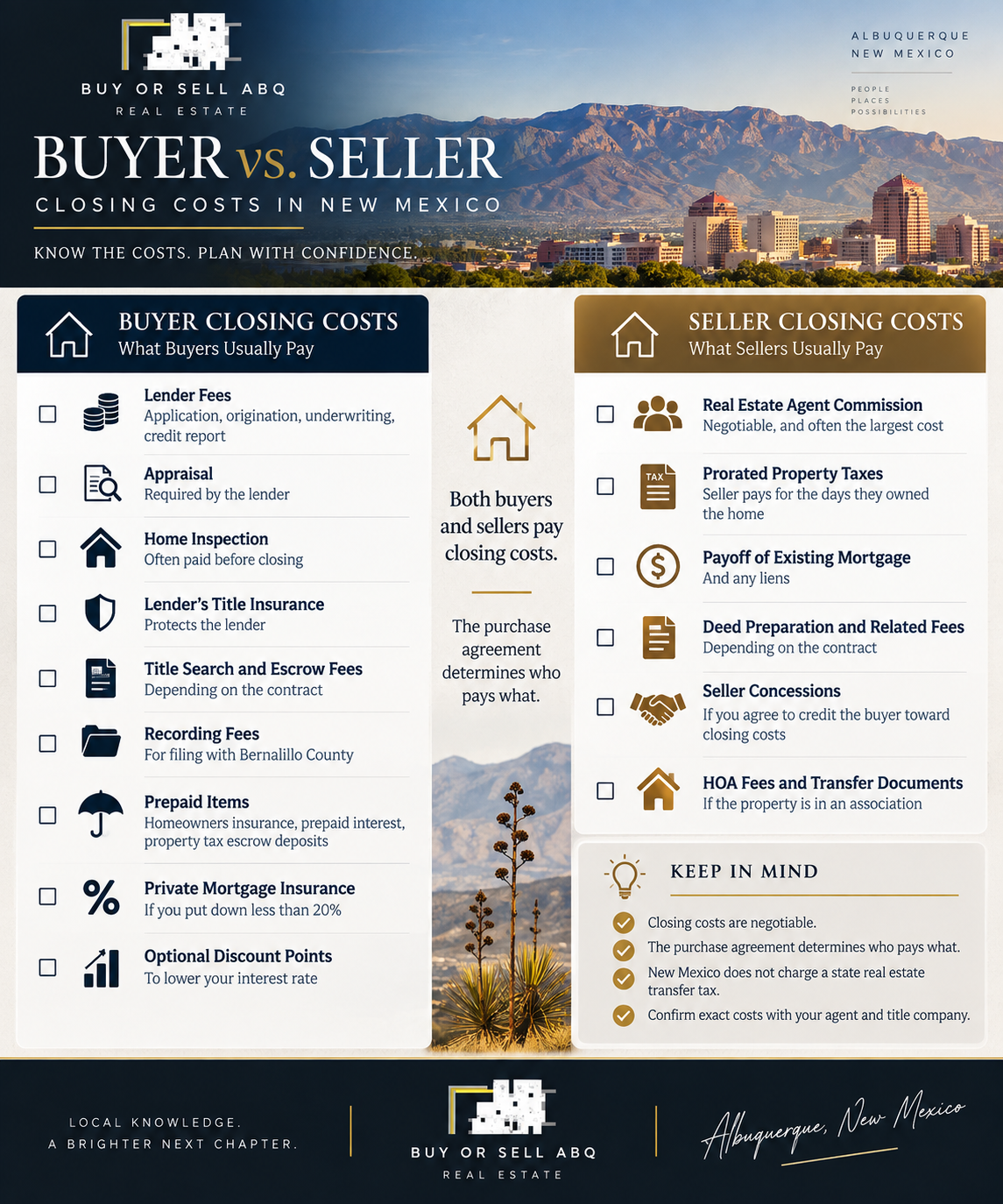
Buyers usually pay for the costs connected to financing and protecting the purchase:
- Lender fees: application, origination, underwriting, and credit report fees
- Appraisal: required by the lender to confirm the home’s value
- Home inspection and pest inspection: often paid upfront, before closing
- Lender’s title insurance: protects the lender against ownership problems
- Title search and escrow or closing fees: depending on the contract
- Recording fees: for filing the deed and mortgage with Bernalillo County
- Prepaid items: homeowners insurance, prepaid interest, and property tax escrow deposits
- Private mortgage insurance: if you put down less than 20%
- Optional discount points: to lower your interest rate
If you are using a VA loan, some fees are limited by VA rules. Our [VA loan guide for Albuquerque buyers] explains what veterans can and cannot pay.
What Do Sellers Pay at Closing in Albuquerque?
Sellers typically pay costs tied to transferring the property:
- Real estate agent commission: fully negotiable, and often the largest seller cost
- Prorated property taxes: the seller pays for the days they owned the home during the tax period
- Payoff of the existing mortgage and any liens
- Deed preparation and related title fees: depending on the contract
- Seller concessions: if you agree to credit the buyer toward their costs
- HOA fees and transfer documents: if the property is in an association
Commission structures have shifted in recent years, and buyer agent compensation is now negotiated more openly. If you are selling, ask your agent to walk through a net sheet so you see your estimated proceeds before you list. Our post on [the biggest mistakes Albuquerque home sellers make] covers other costly errors to avoid.
Who Pays What? A Quick Comparison
| Cost | Usually paid by | Notes |
| Loan origination and underwriting | Buyer | Varies by lender |
| Appraisal | Buyer | Required by the lender |
| Home inspection | Buyer | Paid before closing |
| Lender’s title insurance | Buyer | Protects the lender |
| Owner’s title insurance | Varies | Set by the purchase agreement |
| Escrow or closing fee | Varies | Often negotiated or split |
| Recording fees | Varies | Depends on the document |
| Agent commissions | Seller | Negotiable |
| Prorated property taxes | Both | Each pays for their own days |
| Prepaid insurance and interest | Buyer | Due at closing |
| Mortgage payoff and liens | Seller | Deducted from proceeds |
Treat this table as a general guide. Your contract controls who pays each item.
What Affects Closing Costs in New Mexico?
Several factors move your total up or down:
- Home price: many fees are percentage-based, so they rise with the price
- Loan type: FHA, VA, USDA, and conventional loans each carry different fees and insurance requirements
- Down payment: less than 20% down usually means mortgage insurance
- Location: recording fees, taxes, and insurance can differ by county and city
- Title and escrow provider: fees vary between companies
- Closing date: the closing date affects how much prepaid interest and tax proration you owe
One good thing about New Mexico is that it does not charge a state real estate transfer tax, which keeps one common closing cost off your bill.
How to Reduce Your Closing Costs in New Mexico
You cannot change every fee, but you have more control than you might think:
- Ask for seller concessions. The seller can agree to credit you toward your closing costs. The limit depends on your loan type, so check with your lender.
- Shop for a lender. Compare Loan Estimates from at least two or three lenders. Origination and processing fees vary.
- Look into MFA programs. The New Mexico Mortgage Finance Authority offers programs for eligible buyers that can help with down payments and closing costs. Income and purchase price limits apply.
- Choose your closing date carefully. Closing near the end of the month generally reduces the prepaid interest you owe.
- Compare title and escrow quotes where the contract allows you to choose.
- Ask about a no-closing-cost option. Some lenders roll fees into the loan or adjust the interest rate. It lowers your cash due at closing but can raise your total cost over time.
Frequently Asked Questions
Who pays closing costs when selling a house in New Mexico?
Sellers usually pay agent commissions, their share of prorated property taxes, and any loan payoff. Other items depend on the purchase agreement.
Does New Mexico require a real estate attorney?
No. New Mexico does not require an attorney for a home purchase or sale. Most transactions are handled by real estate agents, title companies, and escrow officers. Some buyers and sellers still hire an attorney for complicated situations.
When will I find out my closing costs?
Your lender must send a Loan Estimate within three business days of your application. You receive your Closing Disclosure with final numbers at least three days before closing.
Are closing costs tax deductible?
Most are not. Prepaid mortgage interest and prorated property taxes may qualify in the year you buy, so ask a tax professional about your situation.
Can I roll closing costs into my loan?
In some cases, yes. It depends on the loan type and lender. Rolling costs into the loan can raise your monthly payment or interest rate, so compare the total cost.
Plan Ahead Before You Buy or Sell
So, who pays closing costs in New Mexico? Both sides do, and a good agent can help you negotiate a fair split. Buyers should plan for roughly 2% to 3% of the purchase price on top of their down payment, and sellers should ask for a net sheet early so there are no surprises at closing.