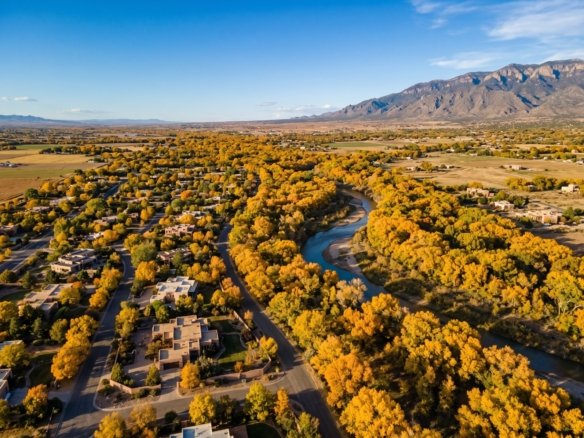
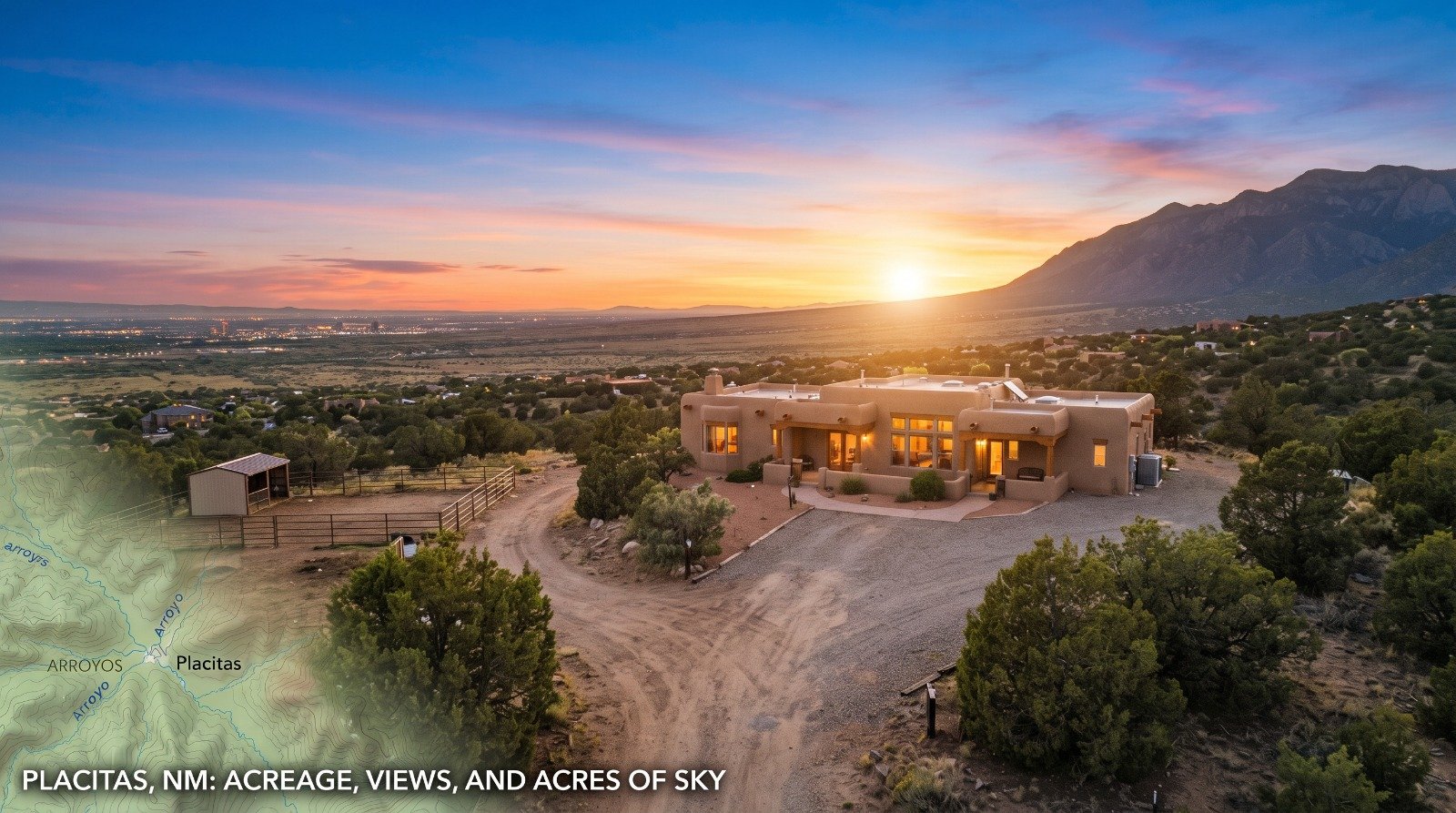
Placitas sits 20 minutes north of Albuquerque with land, views, and a quiet that the city cannot replicate. Here is what buyers need to understand about the market, the terrain, the infrastructure, and the specific questions that determine whether Placitas is the right fit.
Placitas NM real estate — the land and property guide for buyers who want space without losing everything else
Placitas attracts a specific kind of buyer. Not the buyer looking for a neighborhood with HOA-maintained landscaping and a community pool. The buyer who has spent years in a standard residential lot wondering what it would feel like to step outside in the morning and see nothing but land and sky in front of them.
That buyer usually finds Placitas somewhere between the first search and the fifth. It comes up when the search criteria include acreage, privacy, and a commute to Albuquerque that does not require moving to another county.
Tori Domaille at Elite Homes Realty has been working the Placitas market alongside Albuquerque for nearly three decades. The buyers who find Placitas and get it right tend to arrive with a clear picture of what they need from the land and a realistic understanding of what rural infrastructure requires. The buyers who regret it usually discovered both of those things after closing.
This is the guide that makes the difference.
What Placitas actually is — geographically and practically
Placitas sits in Sandoval County at the base of the Sandia Mountains’ northern slope, roughly 20 to 30 minutes north of Albuquerque depending on the specific address and the time of day on I-25. The elevation runs from around 5,800 feet at the lower end of the community to over 6,500 feet on properties that climb toward the mountain.
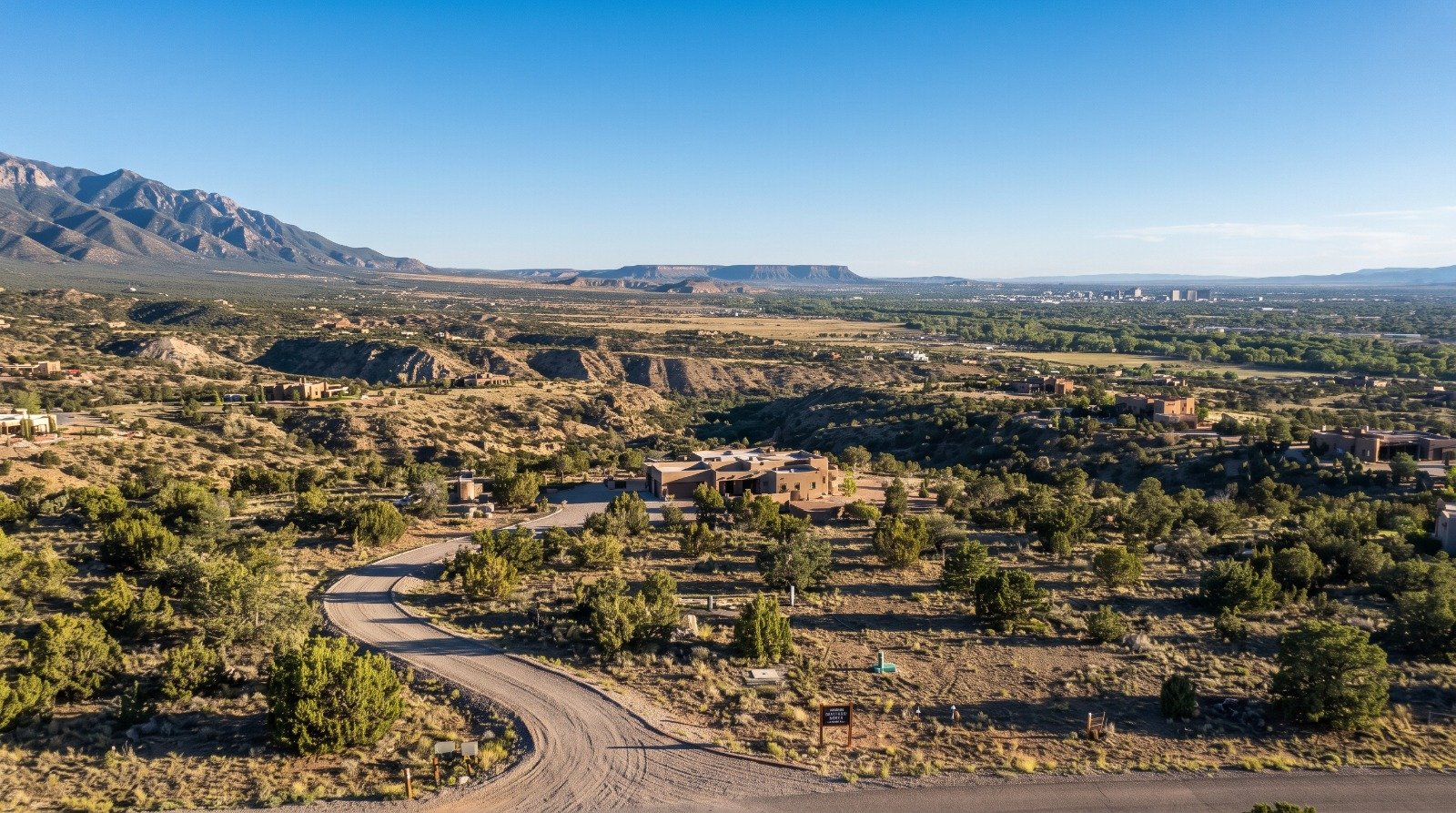
It is not an incorporated town. Placitas has no municipal government, no city services, and no commercial district beyond a small cluster of businesses along NM-165 that covers basic necessities without covering much else. The community identity comes from the residents themselves and from the land — wide lots, long views across the Rio Grande Valley to the west, and a high desert landscape that transitions from chamisa and juniper scrub at lower elevations to piñon and ponderosa on the slopes above.
The Rio Grande Valley stretches out below Placitas to the west with an unobstructed quality that makes even modest lots feel substantially larger than their acreage suggests. This view orientation is one of Placitas’s most consistent selling points — sunset from a west-facing property in Placitas on a clear evening is the kind of thing that makes buyers stop explaining why they are moving there and just show photographs instead.
The land — what buyers actually find and what they need to know before purchasing
Placitas properties range from half-acre lots in the more developed subdivisions near the highway to 10 and 20-acre parcels on the slopes and mesa tops above. The distribution of lot sizes across the community reflects several decades of subdivision development at different scales — some areas were platted for smaller residential lots, others retained larger agricultural parcels that have sold and sometimes been subdivided further over time.
The terrain on larger parcels is rarely flat. Placitas sits on a series of ridges, arroyos, and slopes that produce the views and the privacy that buyers come for — and that require buyers to think carefully about where on the lot a home site actually works, how access reads during different seasons, and what drainage does during a significant monsoon rain event.
Arroyos are the drainage channels that cut through the high desert landscape and carry storm runoff during rain events. In the Albuquerque valley, arroyos are a managed infrastructure concern. In Placitas, they are natural features that cross private property and in some cases constitute the boundaries between parcels. A buyer who purchases a Placitas property without understanding which arroyos cross it, which direction water moves across the lot during a storm, and whether any improvements sit within a drainage path is carrying a risk that a thorough site inspection addresses before it becomes a problem after closing.
Road access varies considerably across Placitas. The main paved roads connecting the community to I-25 are maintained by Sandoval County. The roads into individual subdivisions and to remote parcels run a spectrum from well-maintained gravel to tracks that require a high-clearance vehicle and become impassable after significant snow. A buyer purchasing a property accessed by anything other than a county-maintained road needs to understand exactly who is responsible for that road’s maintenance, what the access looks like in February, and whether their daily vehicle handles it without difficulty.
Water — the most important question on any Placitas purchase
Water in Placitas is the conversation that determines more purchase decisions than price. The community has no municipal water system. Properties rely on private wells, shared community water systems, or water hauling depending on the specific location.
Private wells vary considerably in depth and production rate depending on where the property sits in relation to the local aquifer. Well depth in Placitas ranges from under 100 feet in areas with accessible groundwater to over 600 feet in drier zones. A shallow well producing 5 gallons per minute is a different situation than a deep well producing 1 gallon per minute, and the cost difference between them in daily usage terms shows up when there are horses on the property, a large garden, or a household with high water demand.
The water test that accompanies a Placitas purchase should cover not just quantity — how many gallons per minute the well produces under sustained pumping — but quality. Minerals, bacteria, and other compounds vary by well and by depth, and a buyer who has only tested quantity without quality has an incomplete picture of what they are drinking and what they are putting into any plumbing and appliances that the water runs through.
Community water associations exist in certain Placitas subdivisions and provide a degree of infrastructure stability that a private well does not — shared maintenance costs, backup systems, and a collective resource rather than a single household’s equipment. The trade-off is monthly fees and the occasional assessment when infrastructure needs replacement. Neither arrangement is universally better. The right answer depends on the property, the usage profile, and the buyer’s tolerance for managing their own water supply versus sharing it.
Some remote Placitas properties rely on cisterns filled by water hauling trucks on a regular schedule. This is a functioning arrangement for households that plan for it and budget for it consistently. It is a serious inconvenience for households that did not understand this was the arrangement when they bought.
Septic, power, and connectivity — the infrastructure picture
Along with water, buyers need to understand the septic, power, and internet situation before any purchase commitment is made.
Septic systems are the standard wastewater solution across Placitas. Standard perc-test-approved septic works well across much of the community. In rockier, less permeable terrain — which covers a meaningful portion of the higher elevations — alternative systems are required, and the engineering and installation cost for these runs substantially higher than a conventional septic. A buyer whose budget assumed conventional septic and whose lot requires an engineered alternative is looking at a construction cost difference that belongs in the purchase price negotiation rather than in the contractor’s bill after closing.
Electrical service reaches most of Placitas through overhead lines maintained by the local cooperative. Remote parcels sometimes require a significant line extension to reach the building site — a cost that can run from a few thousand dollars to substantially more depending on distance and terrain. A site that looks like a reasonable home site on a map looks very different when the utility connection estimate comes back.
Internet connectivity in Placitas has improved meaningfully with the expansion of fixed wireless and satellite options, and the growth of remote work has accelerated infrastructure investment in areas that previously had limited options. Buyers who work remotely full time should test actual service speeds at the specific property rather than relying on coverage maps, which tend to represent theoretical coverage more than the service speed a specific address with a specific topographic relationship to the nearest tower actually receives.
What Placitas costs — and what that budget actually buys at each price point
Placitas prices span a range wide enough that generalizing about the market does more harm than good. A half-acre lot with a 1990s custom home and a basic well in one of the lower subdivisions occupies a completely different price bracket than a 5-acre ridge property with a newer custom home, a strong well, mountain views, and valley views simultaneously.
Entry into the Placitas market on the land-only side requires understanding that the cost of the lot is the beginning of the number, not the number. A raw 5-acre parcel with no well, no septic, no power connection, and no road improvements is priced as raw land. Developing it to the point where construction can begin involves site assessment, well drilling, septic engineering and installation, power connection, and in some cases road grading — a sum that adds materially to the total cost and needs to be calculated honestly before a lot purchase decision is made.
Buyers who compare a Placitas lot price to an Albuquerque city lot price without accounting for the infrastructure gap are not comparing equivalent things. The city lot has water, sewer, power, paved access, and an address that FedEx can find on the first try. The Placitas lot has the land, the view, and the potential — what it takes to make it buildable is a separate line item.
On the improved property side — homes with existing wells, septic, and power — Placitas delivers genuine value relative to comparably sized properties in Albuquerque. An acre in Placitas with a functioning custom home goes further in terms of land, privacy, and setting than the same money buys in the Foothills or North Albuquerque Acres. That value proposition drives consistent buyer interest in the community from buyers who have priced the Foothills and found themselves wanting more land for the same money.
The horse property question
Placitas is one of the more practical locations in the greater Albuquerque area for buyers who need horse facilities, and the combination of lot size, zoning, and trail access from some properties makes it worth a specific mention for that buyer category.
Sandoval County zoning in most of Placitas permits livestock on properties with sufficient acreage. The practical requirements — a minimum lot size that accommodates a paddock, barn, and appropriate setbacks from neighboring properties — are met by a meaningful portion of the community’s inventory.
The Placitas trail system connects to the Cibola National Forest on the mountain slopes above, which provides access to riding terrain that no Albuquerque city lot can match. Buyers who want to ride out from their back gate rather than trailering horses to a staging area will find that Placitas properties with direct or near-direct trail access carry a premium that reflects exactly that.
Water for horse operations requires a more honest look at well production rates than a household with only human occupants. A property supporting two horses, a vegetable garden, and a household of three needs a well that produces consistently under sustained demand — not just enough for a morning and evening test. This is the well capacity conversation that should happen with the seller and with a licensed water systems professional before offer submission, not after the inspection contingency expires.
Working with Elite Homes Realty in Placitas
Placitas transactions involve a set of contingencies and due diligence steps that standard residential purchases in Albuquerque do not. Water tests, septic assessments, well production testing, road access evaluation, utility connection costs, and arroyo drainage are all part of a Placitas purchase that a buyer going in without local representation can miss.
Tori Domaille and the team at Elite Homes Realty have been closing Placitas transactions alongside Albuquerque work for nearly three decades. The specific questions that determine whether a Placitas property is the right purchase — not just the right concept — are the ones they ask before the offer goes in. Properties that look right on paper and perform correctly in person are the ones worth buying. The ones that look right on paper and have a water situation that requires extensive investment or a road that becomes inaccessible in winter are worth knowing about before commitment rather than after.
The conversation about Placitas starts with what you need the land to do. That question drives every property decision that follows.
Elite Homes Realty
📍 8812 Natalie Ave NE, Albuquerque, NM 87111
📞 +1 (505) 639-0067
🔗 buyorsellabq.com
Tori Domaille is the Broker and Owner of Elite Homes Realty and has worked Albuquerque and Placitas real estate since 1996. The team serves buyers across Albuquerque, Placitas, the East Mountains, and surrounding communities.